UNION THE PICTURE OF THE VINE AND HIS BRANCHES

The Body and the head are definitely one and the body is dead without being in union with the body. Another great picture of union is the Vine.

THE PICTURE OF THE VINE IN A VINEYARD

John 15ff

Jhn 15:1

I am the true vine, and my Father is the husbandman.

“I am the true vine: This was a familiar symbol. God repeatedly used a vine as a symbol of His people in the Hebrew Scriptures (one example is Psalm 80:8-9). Yet it was often used in a negative sense (as in Isaiah 5:1-2, 7 and Jeremiah 2:21). Just in the previous week Jesus publicly taught about Israel being like a vineyard in the Parable of the Vineyard (Matthew 21:33-44).” David Guzak

This teaching was given to His disciples on the night He was to be betrayed and arrested. These were His words to keep them in Christ even after He was leaving His earthly ministry.

HE was encouraging them to stay in Him connected to the Vine.

In Psalm 80 Asaph compared Israel to a Vine taken out of Egypt and planted in Canaan. A vine represents Israel as Gods people. But after they rejected the Vineyard masters son they no longer were connected to the Vine and no longer Gods people. They who rejected Jesus cut them selves off the source of life. The Vine was Jesus.

Psa 80:15

And the vineyard which thy right hand hath planted, and the branch that thou madest strong for thyself.

Psa 80:16

It is burned with fire, it is cut down: they perish at the rebuke of thy countenance.

This prophecy was fulfilled in 70AD when the temple and Jerusalem was burned.

Israel is not a race or not a place. It means a people who love God and are united to God throught the Vine who is Jesus, the Son of the Vineyard master.

Here again in Isaiah you can see the prophecy that came to reality after Israel rejected the Vine.

Isa 5:1

Now will I sing to my wellbeloved a song of my beloved touching his vineyard. My wellbeloved hath a vineyard in a very fruitful hill:

After all Israel as the vineyard belonged to the Vineyard owners Son. Who was the real vine.  HE was Gods beloved and all those who stay in Christ are part of the Vine also and so are part of the Vineyard. The true Israel of God.

Isa 5:2

And he fenced it, and gathered out the stones thereof, and planted it with the choicest vine, and built a tower in the midst of it, and also made a winepress therein: and he looked that it should bring forth grapes, and it brought forth wild grapes.

Isa 5:3-4

And now, O inhabitants of Jerusalem, and men of Judah, judge, I pray you, betwixt me and my vineyard. What could have been done more to my vineyard, that I have not done in it? wherefore, when I looked that it should bring forth grapes, brought it forth wild grapes?

God has done his part preparing for His son and Israel but they cut themselves off from God and all Gods preparation and work produced nothing but strange and sour grapes.

Isa 5:5

And now go to; I will tell you what I will do to my vineyard: I will take away the hedge thereof, and it shall be eaten up; and break down the wall thereof, and it shall be trodden down:

This literally happened when Titus sent his siege around Jerusalem and the wall came down.

Isa 5:6-7

And I will lay it waste: it shall not be pruned, nor digged; but there shall come up briers and thorns: I will also command the clouds that they rain no rain upon it. For the vineyard of the LORD of hosts is the house of Israel, and the men of Judah his pleasant plant: and he looked for judgment, but behold oppression; for righteousness, but behold a cry.

The vineyard of the Lord is Israel. But Israel remains God’s vineyard as long as they stayed connected to the Vine, Jesus Christ.

Rom 11:1

I say then, Hath God cast away his people? God forbid. For I also am an Israelite, of the seed of Abraham, of the tribe of Benjamin.

God would never caste any one away. But people cast God away every day. How?

Rom 11:17

And if some of the branches be broken off, and thou, being a wild olive tree, wert graffed in among them, and with them partakest of the root and fatness of the olive tree;

Here the picture of the vineyard and the grape vine is replaced by an Olive plant. The Fig, the olive and the Grape were always pictures God use to explain his relation with His people. It was Israel until they rejected His Son and cut themselves off. They should have took part and shared fully with the source of all fatness of the plant, the root was Jesus.

Yet the gentiles and all races were meant to be part of this vineyard Israel and God made a Vine that any one could join by faith.

Rom 11:20

Well; because of unbelief they were broken off, and thou standest by faith. Be not highminded, but fear:

It was pride and unbelief that caused the Pharisees to cry “Crucify Him!” and so Gentiles too should be humble and believe to be part of this Vine.

This Vineyard of God is the Kingdom of God that Jesus came to proclaim to Israel

UNION DU CORPS


C’est ainsi que nous avons été tissés ensemble dans le ventre de notre mère !
Job 10:11
Tu m’as revêtu de peau et de chair, et tu m’as entouré d’os et de tendons.
Le mot “tendon” en hébreu ou en grec ancien peut aussi signifier “nerfs”.
Toutes les parties du corps, le corps humain charnel, ont été mises ensemble pour la force. Et lorsqu’il y a unité, comme dans une tapisserie tissée serrée, il y a force. Ce vase d’argile est temporaire mais il nous montre que l’unité du corps du Christ est également tissée dans un ordre que seuls le Créateur et la Tête du Christ peuvent organiser. Nous nous tournons vers le Christ pour qu’il garde nos corps terrestres intacts et nous faisons de même pour le corps du Christ.
Regardez la révélation que David a reçue au sujet du corps humain
Psa 139:13
Car tu as pris mes rênes, tu m’as couvert dans le sein de ma mère.
Psa 139:15
Mes os ne t’étaient pas cachés, quand j’étais fait dans le secret, dans les profondeurs de la terre. (les parties inférieures de la terre sont une manière poétique de se référer au ventre de la mère, caché de la vue).
1Co 12:12
De même que le corps est un et a plusieurs membres, mais que tous les membres du corps, étant nombreux, ne forment qu’un seul corps, ainsi en est-il du Christ.
Ce corps humain, qui a été créé de manière impressionnante, n’est qu’un reflet du corps éternel du Christ.
1Co 12:13
Car c’est aussi par la puissance d’un seul Esprit que nous avons tous été baptisés en un seul corps, Juifs ou Grecs, esclaves ou libres, et que nous avons tous été abreuvés d’un seul Esprit.
Nous sommes totalement baptisés en Christ et nous sommes totalement remplis de l’esprit de Christ.
1Co 12:14
Car aussi le corps n’est pas un seul membre, mais plusieurs.
Et c’est une chose impressionnante et merveilleuse que nous ayons tant d’organes et de cellules dans un corps sain, qui interagissent en parfaite harmonie. Si nous perdons cet ordre et cette harmonie donnés par Dieu, nous tombons malades. De même, la division du corps de Christ en dénominations a provoqué la maladie.
1Co 12:15
Si le pied dit : Parce que je ne suis pas une main, je ne fais pas partie du corps, est-ce à cause de cela qu’il ne fait pas partie du corps ?

De même que la perte d’une main affecte tout le corps, la perte d’un seul membre du corps de Christ l’affecte. Nous avons besoin de chaque personne qui le compose. Et chaque personne a une fonction particulière. Celles-ci peuvent changer au fur et à mesure que le corps grandit. De nouvelles dents peuvent remplacer les anciennes dents de lait. Vous pouvez développer des biceps et des triceps en faisant de l’exercice. Mais tous les organes obéissent aux nerfs qui les commandent depuis le cerveau, ou la tête qui est le Christ.
1Co 12:16
Et si l’oreille dit : Parce que je ne suis pas un œil, je ne fais pas partie du corps, est-ce à cause de cela qu’elle ne fait pas partie du corps ? Imaginez une personne qui ne serait qu’un globe oculaire. Il n’irait pas loin sans pieds. Mais surtout, l’œil ou tout autre organe mourrait dès qu’il quitterait le corps.
La source de sang et les nerfs ne lui apporteraient plus la vie.
Il en va de même lorsque nous n’écoutons pas l’esprit ou la révélation qui vient par le biais du Christ.
Co 12:17
Si tout le corps était un œil, où serait l’ouïe ? Si tout le corps était l’ouïe, où serait l’odorat ?
Tout comme le corps a besoin de chacune de ses parties, telles que Dieu les a placées dans le ventre de nos mères, nous avons besoin les uns des autres. Chaque fonction est tout aussi importante dans le corps physique et nous ne le savons peut-être pas jusqu’à ce qu’il nous manque une partie.
1Co 12:18
Mais maintenant, Dieu a placé les membres, chacun d’eux dans le corps, selon qu’il lui a plu.
Tout comme Dieu a merveilleusement conçu nos corps de chair, il a un plan pour le Corps du Christ. Mais il ne fonctionne et ne croît que si nous suivons la tête. Dieu en Christ en nous.
1Co 12:19
Mais si tous étaient un seul membre, où serait le corps ?
1Co 12:20
Mais maintenant, les membres sont nombreux, et le corps est un.
L’union et l’unité sont exprimées comme un.
Le corps et la tête sont définitivement un et le corps est mort sans être en union avec le corps.

PICTURE OF UNION ….THE BODY

This is how we were knit together in the womb!

Job 10:11

Thou hast clothed me with skin and flesh, and hast fenced me with bones and sinews.

« sinews in the ancient Hebrew or Greek can also be « nerves »

All the parts of the body, the fleshly human body, were put together for strength. And when there is unity as in a tapestry woven tightly together there is strength. This clay vessel is temporary yeti t shows us that the unity of the body of Chirst also is woven together in an order that only the Creator and the Head Christ can organize. We look to Christ to keep our earthly bodies intact and so do we do the same for the Body of Christ

Look at the revelation David received about the human body

Psa 139:13

For thou hast possessed my reins; thou didst cover me in my mother’s womb.

Psa 139:15

My bones were not hidden from thee when I was made in secret, curiously wrought in the lower parts of the earth.  (the lower part of the earth are a poetic way of refering to the womb, hidden from view)

1Co 12:12

For even as the body is one and has many members, but all the members of the body, being many, are one body, so also is the Christ.

This human body that was awesomely created, is just a reflexion of the eternal Body of Christ.

1Co 12:13

For also in the power of one Spirit *we* have all been baptised into one body, whether Jews or Greeks, whether bondmen or free, and have all been given to drink of one Spirit.

We are totally baptised into Christ and we are totally filled with the the spirit of Christ.

1Co 12:14

For also the body is not one member but many.

And it is a awesome and wonderful thing that we have so many organs and cells in a healthy body, that interact in perfect harmony.  If we lose this God given order and harmony we become diseased. So also the dividing of the body of Christ into denominations caused sickness.

1Co 12:15

If the foot say, Because I am not a hand I am not of the body, is it on account of this not indeed of the body?

Just as loping off your hand will affect your whole body, losing a single member in the Body of Christ will affect it. We need each person in it. And each person has a particular function. These may change as the body grows.  You may have new teeth replace old milk teeth. You may develop Biceps and triceps as you excercise.  But all the organs are obedient to the nerves that control from the brain, or the Head who is Christ.

1Co 12:16

And if the ear say, Because I am not an eye I am not of the body, is it on account of this not indeed of the body?Imagine a person that was just an eye ball.  He would not fo to far without feet. But most of all the eye or any organ would die as soon as it leaves the body.

The source of blood and nerves would no longer bring life to it.

So it is when we are not listening to the spirit or the revelation that comes by way of Christ.

Co 12:17

If the whole body were an eye, where the hearing? if all hearing, where the smelling?

Just as the body needs each part as God placed it in our mothers womb, we need each other. Each function is just as important in the physical body and we may not  know it until we have a part missing.

1Co 12:18

But now God has set the members, each one of them in the body, according as it has pleased him.

Just as God wonderfully designed our bodies of flesh He has a plan for the Body of Christ. But it only works and grows if we follow the Head.  God in Christ in us.

1Co 12:19

But if all were one member, where the body?

1Co 12:20

But now the members are many, and the body one

Union and unity is expressed as one.

The Body and the head are definitely one and the body is dead without being in union with the body.

Photos de l’union

Photos de l’union
Paul Ellis
” L’union spirituelle est un concept tellement étranger à l’esprit naturel que la Bible nous fournit des images pour nous aider à le saisir. Dans le Nouveau Testament, notre union avec le Seigneur est décrite comme une vigne et ses sarments (Jean 15:5), un bâtiment ou un temple (voir l’entrée pour 2 Cor. 6:16), un trésor dans une jarre d’argile (2 Cor. 4:7), un nouvel homme (Eph. 2:15), un mariage (2 Cor. 11:2, Eph. 5:24-25, Apo. 19:7, 21:9, 22:17), une ville (Héb. 11:10, 12:22, 13:14, Apo. 3:12, 21:2), et une famille ou un foyer (Mt. 12:50, Marc 3:35, Jean 11:52, 2 Cor. 6:18, Eph. 2:19, Gal. 3:26, 6:10, 1 Pi. 4:17). La métaphore de l’union qui apparaît le plus souvent dans le Nouveau Testament est celle du corps du Christ dont chaque croyant est membre (voir l’entrée pour 1 Cor. 12:27 ; voir aussi Rom. 12:4, 5, 1 Cor. 6:15, 10:17, 12:12-18, 22-25 , Eph. 3:6, 4:4, 4:15-16, 5:23, 30, Col 1:18, 2:19, 3:15). “
Une illustration fantastique de la façon dont le croyant est en union avec la tête et le corps, représentant Christ et son corps, l’église est le corps humain. On peut apprendre beaucoup de choses avec cette analogie. Dieu a créé tous les organes et la façon dont ils fonctionnent en harmonie, ainsi que l’église et tous ses membres.
Je voudrais d’abord regarder cette illustration
L’IMAGE DU CORPS
Eph 4:16
De qui tout le corps, bien uni et coordonné par l’action de toutes les articulations, selon l’efficacité de chaque partie, contribue à l’accroissement du corps pour son édification dans la charité.
Le corps entier commence par la tête et le corps se développe à partir de celle-ci. Tout comme l’embryon humain commence par la tête, nous, le corps du Christ, grandissons à partir de la tête qui est le Christ.
Eph 4:15
En parlant de la vérité dans la charité, nous devons grandir en lui à tous égards, lui qui est la tête, le Christ :
Mais dans le corps, ce sont les hormones du cerveau qui stimulent la croissance et déterminent la place de chaque cellule pendant qu’elle se développe pour former chaque organe. Même si chaque cellule a le modèle pour devenir chaque chose dans le corps, elle est dirigée par la tête pour être ce qu’elle est appelée à être.
L’analogie est que nous avons toute la plénitude du Christ en nous lors de notre nouvelle naissance d’en haut. Tout le potentiel pour être chaque membre mais nous sommes soumis à la tête du Christ pour être dirigés par son esprit pour être ce que nous sommes, des membres en particulier.
Cette croissance dans le Corps du Christ est semblable à celle de l’embryon humain. “Elle est caractérisée par les processus de division et de différenciation cellulaire de l’embryon qui se produisent au cours des premiers stades du développement. “Extrait de wikipedia Développement embryonnaire humain.
” Ces voies de signalisation permettent le réarrangement des cellules et assurent la formation d’organes à des endroits spécifiques de l’organisme[1] ” C’est ce qui se passe dans le développement tel qu’il a été conçu par le Créateur pour les animaux et les humains. Mais dans le Corps du Christ, c’est l’esprit et la révélation qui provoquent la croissance…Dire la vérité ou mieux traduit ” Être vrai dans l’Amour ” favorise la croissance. .
” Heinz Christian Pander a découvert que les couches germinales ne peuvent pas former leurs organes respectifs sans les interactions cellulaires des autres tissus. “Extrait de wikipedia Mécanisme de formation des organes.
Nous grandissons aussi en harmonie avec tous les autres membres en Christ.
” Une étape primaire de l’organogenèse chez les chordés est le développement de la notocorde, qui induit la formation de la plaque neurale, et finalement du tube neural dans le développement des vertébrés. Le développement du tube neural donnera naissance au cerveau et à la moelle épinière[1]. Les vertébrés développent une crête neurale qui se différencie en de nombreuses structures, notamment des os, des muscles et des composants du système nerveux central. “
Ce que les scientifiques considèrent comme la cause du développement provient de la tête ou des tissus qui forment le cerveau appelé la ” notochorde ” et celle-ci envoie des messages sous forme de protéines ou de produits chimiques pour modifier toutes les autres cellules. On les appelle les ” morphogènes “.
Nous aussi, nous sommes changés et continuons à être métamorphosés en cessant d’être conformés mais en étant transformés par le rafraîchissement de notre esprit à la volonté de Dieu. La tête est le Christ.
” Un morphogène est une substance dont la distribution non uniforme régit le modèle de développement des tissus dans le processus de morphogenèse ou de formation de modèles, “
” Ces gradients conduisent le processus de différenciation des cellules souches non spécialisées en différents types de cellules, formant finalement tous les tissus et organes du corps. “
De même que les hormones sont régulées par l’hypophyse dans le cerveau et que la croissance de l’embryon commence par les plaques neurales, la croissance dans la nature commence par le cerveau ou la tête.

” L’union spirituelle est un concept tellement étranger à l’esprit naturel que la Bible nous fournit des images pour nous aider à le saisir. Dans le Nouveau Testament, notre union avec le Seigneur est décrite comme une vigne et ses sarments (Jean 15:5), un bâtiment ou un temple (voir l’entrée pour 2 Cor. 6:16), un trésor dans une jarre d’argile (2 Cor. 4:7), un nouvel homme (Eph. 2:15), un mariage (2 Cor. 11:2, Eph. 5:24-25, Apo. 19:7, 21:9, 22:17), une ville (Héb. 11:10, 12:22, 13:14, Apo. 3:12, 21:2), et une famille ou un foyer (Mt. 12:50, Marc 3:35, Jean 11:52, 2 Cor. 6:18, Eph. 2:19, Gal. 3:26, 6:10, 1 Pi. 4:17). La métaphore de l’union qui apparaît le plus souvent dans le Nouveau Testament est celle du corps du Christ dont chaque croyant est membre (voir l’entrée pour 1 Cor. 12:27 ; voir aussi Rom. 12:4, 5, 1 Cor. 6:15, 10:17, 12:12-18, 22-25 , Eph. 3:6, 4:4, 4:15-16, 5:23, 30, Col 1:18, 2:19, 3:15). “
Une illustration fantastique de la manière dont le croyant est en union avec la tête. a
Il en va de même dans le domaine spirituel. Le corps grandit et fonctionne à partir des ordres de la tête qui est le Christ. Et chaque cellule ou membre du corps est contrôlé par le noyau contenant tout le potentiel pour devenir chaque organe dans l’ADN. Ce sont les morphogènes ou hormones qui amènent le potentiel à sa manifestation. Du génotype au phénotype.
La nature est tellement alignée avec le spirituel. Le monde physique reflète l’Esprit qui l’a créé. Il peut aussi refléter le mal qui le détruit (parasites ou prédateurs).

PICTURES OF UNION

Pictures of union

Paul Ellis

« Spiritual union is such an alien concept to the natural mind that the Bible provides us with pictures to help us grasp it. In the New Testament, our union with the Lord is portrayed as a vine and its branches (John 15:5), a building or temple (see entry for 2 Cor. 6:16), a treasure in a jar of clay (2 Cor. 4:7), a new man (Eph. 2:15), a marriage (2 Cor. 11:2, Eph. 5:24-25, Rev. 19:7, 21:9, 22:17), a city (Heb. 11:10, 12:22, 13:14, Rev 3:12, 21:2), and a family or household (Matt. 12:50, Mark 3:35, John 11:52, 2 Cor. 6:18, Eph. 2:19, Gal. 3:26, 6:10, 1 Pet. 4:17). The union metaphor which appears most often in the New Testament is that of the body of Christ of which every believer is a member (see entry for 1 Cor. 12:27; see also Rom. 12:4, 5, 1 Cor. 6:15, 10:17, 12:12-18, 22-25 , Eph. 3:6, 4:4, 4:15-16, 5:23, 30, Col 1:18, 2:19, 3:15). »

One fantastic illustration of how the believer is in union with the head and the body, meaining Christ and His body, the church is the human body. A lot can be learned in this analogy. GOd crerated the all the organs and how they work in harmony as well as the church and all its members

I would like to first look at this illustration

THE PICTURE OF THE BODY

Eph 4:16

From whom the whole body fitly joined together and compacted by that which every joint supplieth, according to the effectual working in the measure of every part, maketh increase of the body unto the edifying of itself in love.

The whole body starts with the head and the body grows out of it.  Just as a human embryo starts with the head we, the body of Christ, grow out of the head who is Christ.

Eph 4:15

But speaking the truth in love, may grow up into him in all things, which is the head, even Christ:

But in the body it is the hormones from the brain that stimulate the growth and determine the place for every cell as it develops to form every organ. Even though each cell has the pattern to become every thing in the body it is directed by the head to be what it is called to be

The analogy is that we have all the fulness in Christ in us at our new birth from above. All the potential to be every member but we are in submission to the head Christ to be directed by way of His spirit to be who we are, members in particular.

This growth in the Body of Christ is similar to the human embryo. « It is characterised by the processes of cell division and cellular differentiation of the embryo that occurs during the early stages of development. » from wikipedia Human embryonic development. 

« These signaling pathways allow for cell rearrangement and ensure that organs form at specific sites within the organism.[1 » This is what takes place in the development as deisgned by the Creator for animals and humans, The signals are chemical in nature. But in the Body of Christ it is spirit and revelation that causes growth…Speaking the truth or better translated « Being true in Love » promotes growth. .

« Heinz Christian Pander discovered that the germ layers cannot form their respective organs without the cellular interactions from other tissues. » from wikipedia Mechanism of organ formation 

We grow also in harmony with all the other members in Christ.

« A primary step in organogenesis for chordates is the development of the notochord, which induces the formation of the neural plate, and ultimately the neural tube in vertebrate development. The development of the neural tube will give rise to the brain and spinal cord.[1] Vertebrates develop a neural crest that differentiates into many structures, including bones, muscles, and components of the central nervous system. »

What the scientists sees as the cause of development comes from the head or the tissues that form the brain called the « notochord » and this sends messages in the form of protein or chemicals to change all the other cells. They call these « morphogens »

We to are changed and continue to be metamorphosized as we stop being conformed but changed by the refreshing of our minds to the will of God. The Head is Christ.

« A morphogen is a substance whose non-uniform distribution governs the pattern of tissue development in the process of morphogenesis or pattern formation, »

« These gradients drive the process of differentiation of unspecialised stem cells into different cell types, ultimately forming all the tissues and organs of the body. »

Like the hormones are regulated  by the pituitary gland in the brain and the grow of the embryo starts with the neural plates, growth in nature starts with the brain or the head.

So it is in the spiritual realm. The body grows and functions from commands from the head who is Christ. And each cell or member in the body is controled by the nucleus containing all the potential to become every organ in the DNA. It is from the morphogens or hormones that bring the potential to its manifestation. From Genotype to phenotype.

Nature is so aligned with the spritual. The physical world mirrors the Spirit that created it. It also can mirror the evil that destroys it (parasites or predators)

Pardonné, réconcilié et sauvé ?

Pardonné, réconcilié et sauvé ?

Posted on mars 13, 2012 by Paul Ellis // 34 Comments

be_reconciledLe monde est vraiment un endroit étrange. Juste quand vous pensez avoir tout vu, quelque chose de nouveau vous frappe sur le côté de la tête. Quand j’étais jeune, la question théologique numéro un était celle-ci : “Sauvé une fois, sauvé toujours ?” Les gens qui posaient cette question voulaient savoir s’il est possible pour un chrétien de perdre son salut. Eh bien, si les grenouilles et les papillons peuvent redevenir des têtards et des chenilles, alors je suppose que c’est possible.

Mais maintenant, une toute nouvelle question est posée, qui est la suivante : Tout le monde est-il sauvé ? Beaucoup répondent par l’affirmative : “Jésus est le Sauveur du monde. Par conséquent, tout le monde est déjà sauvé, ils ne le savent simplement pas.” Avant que vous ne considériez cela comme une hérésie universaliste, laissez-moi ajouter que ceux qui prêchent cette forme de réconciliation historique ne croient pas que tout le monde va au ciel. C’est simplement que tout le monde y est jusqu’à ce que l’incrédulité le chasse.

Comme il s’agit d’un enseignement populaire aujourd’hui, je pense qu’il serait bon pour nous d’y regarder de plus près. Commençons par une déclaration souvent entendue : “Tous sont pardonnés, réconciliés et sauvés.”

A ces trois points, je réponds : (1) c’est vrai (nous sommes pardonnés), (2) c’est en quelque sorte vrai (Dieu a réconcilié le monde mais vous avez encore besoin d’être réconcilié), et (3) ce n’est pas vrai (tous ne sont pas sauvés).

Complètement_pardonné

Vous êtes pardonné

La raison pour laquelle le pardon est une affaire réglée et le salut non, c’est que le pardon est un jeu qui ne nécessite qu’un seul joueur. Dieu n’a pas besoin de votre permission pour vous pardonner. Dans nos esprits humains chétifs, nous avons du mal à comprendre cela car nous ne sommes pas des pardonneurs naturels. Nous gardons de longues traces du mal qui nous est fait. Mais Dieu n’est pas comme nous. Il nous aime d’un amour inconditionnel. Il nous pardonne sans tenir compte de notre comportement et selon la richesse de sa grâce (Ep 1,7). L’amour-agapè ne garde aucune trace des fautes commises, c’est pourquoi Dieu peut choisir de ne plus se souvenir de nos péchés. C’est une merveilleuse nouvelle ! Lorsque vous connaissez son pardon, vous êtes en mesure de vous pardonner et de pardonner aux autres.

Oui, nous avons encore besoin de recevoir son pardon, tout comme nous avons besoin de recevoir sa grâce. Si vous ne croyez pas que vous êtes pardonné, alors vous agirez comme un pécheur non pardonné. Mais nous n’avons pas besoin de demander à Dieu de faire ce qu’il a déjà fait. Le pardon, ainsi que tous les avantages du salut, nous sont accordés en Christ.

J’ai écrit plus sur le pardon que sur n’importe quel autre aspect de la grâce de Dieu, alors si vous avez besoin d’être convaincu que vous êtes éternellement pardonné, commencez par ce billet.

Vous êtes réconcilié ; soyez réconcilié

La réconciliation, contrairement au pardon, est un jeu à deux joueurs. Les deux parties doivent jouer. Prenons le cas d’un mari qui souhaite se réconcilier avec sa femme dont il s’est séparé. Il l’aime d’un amour inconditionnel qui ne garde aucune trace de ses fautes. Dans son esprit, il n’existe aucune blessure ou offense qui n’ait été pardonnée et oubliée. Ainsi, dans son amour, il s’est présenté à la table de la réconciliation en déclarant que tout va bien de son côté. Diriez-vous qu’ils se sont réconciliés ? Cela dépend de la femme. Si elle ne choisit pas de se réconcilier, il n’y a pas de réconciliation.

Imaginons maintenant que l’épouse soit tellement abîmée par une enfance malheureuse qu’elle projette injustement sa détresse sur lui. Même s’il est un parfait gentleman et irréprochable, dans son esprit, son mari est un homme violent et en colère. C’est ainsi que l’humanité déchue entre en relation avec notre Père aimant qui est aux cieux. Bien que Dieu ait été d’une bonté sans faille à notre égard, dans notre état déchu, nous pensons le pire de lui. Nous l’imaginons en colère et violent.

Aussi longtemps que nous sommes séparés de la vie et de l’amour de Dieu par nos offenses imaginaires, sommes-nous réconciliés ? Bien sûr que non. Si l’homme de notre histoire se promenait en disant aux autres que sa femme et lui étaient réconciliés – même si elle continuait à vivre avec un autre homme – ils penseraient qu’il est fou. Pourtant, c’est exactement le message que beaucoup prêchent.

Le monde a-t-il été réconcilié avec Dieu ? La réponse de Paul est “Oui et non”. Du côté de Dieu, la réconciliation est un événement historique. “Tout cela vient de Dieu, qui nous a réconciliés avec lui par le Christ…” (2 Co 5, 18). Dieu est venu à nous à bras ouverts. Il ne retient rien contre nous – ni nos péchés, ni notre passé, ni rien. ” Alors que nous étions encore pécheurs, le Christ est mort pour nous ” (Rm 5,8). Gloire à Dieu !

Cependant, il n’y a pas de réconciliation dans les faits si nous ne répondons pas à ses ouvertures. D’où l’exhortation de Paul : “Nous vous en supplions au nom du Christ : Soyez réconciliés avec Dieu” (2 Co 5, 20). Dieu aime tellement le monde qu’il est venu et est mort pour nous. Son cœur se languit de ceux qui sont perdus et brisés. Il ne veut pas d’une réconciliation historique qui n’est pas vraie aujourd’hui. Il veut ses enfants !

Ceux qui prêchent la réconciliation historique soutiennent que l’éloignement de l’homme déchu est basé sur un mensonge. Les hommes craignent Dieu inutilement et je suis d’accord. Dieu n’est pas en colère contre nous. Il nous aime vraiment. Et il n’y a certainement rien de mal à prêcher que Dieu nous a réconciliés avec Lui par le Christ, puisque c’est ce que Paul a prêché. Mais avec la même passion, nous devons aussi prêcher l’autre côté, comme Paul l’a fait : Nous vous en supplions – soyez réconciliés avec Dieu.

Êtes-vous sauvé ?

J’ai entendu certains affirmer que le monde entier est sauvé, comme si cette déclaration allait amener les non sauvés à revenir à la raison et à se comporter en sauvés. Jusqu’à présent, je n’ai pas vu cela se produire. Le Père a aimé le prodigue à tous les moments de l’histoire, mais il n’a jamais poursuivi son fils dans la ville en lui disant “Tu es à moi ! Reviens à la maison.” S’il l’avait fait, ses cris seraient tombés dans l’oreille d’un sourd. Le fils a été le fils pendant toute l’histoire, mais séparé de son père, il était un fils perdu. Il n’a été “sauvé” que lorsqu’il s’est retourné et s’est retrouvé dans les bras de son père.

Alors, le monde entier est-il sauvé ou non ? Si la réponse est oui, alors pourquoi y a-t-il tant d’écritures indiquant que Dieu veut que nous soyons sauvés (1 Tim 2:4) et qu’il commande maintenant aux gens du monde entier de se repentir (Actes 17:30) et de croire au nom de son Fils (1 Joh 3:23) pour être sauvés (Mc 16:16), etc. D’après mes calculs, il existe plus de deux douzaines d’écritures exhortant spécifiquement les gens à être sauvés et littéralement des centaines d’autres les exhortant à se repentir, à croire, à recevoir, à avoir la foi, à faire confiance à Dieu, etc.

Pour autant que je sache, il n’y a pas un seul verset de la Bible qui affirme catégoriquement que toute l’humanité a été sauvée à la croix. Certes, Jésus a pourvu à notre salut – Son œuvre est achevée. Il est certain que la volonté du Père est que tous soient sauvés et qu’aucun ne périsse. Mais sa volonté n’est pas la seule dans l’équation. Il faut deux personnes pour établir une relation et c’est pourquoi les auteurs du Nouveau Testament répètent que tous ne sont pas sauvés. Je n’ai pas le temps d’approfondir le sujet ici, mais si vous êtes intéressé ou si vous vous interrogez sur un passage particulier, je vous encourage à consulter mes notes d’étude faciles à lire.

Et alors ?

Est-ce vraiment important de dire aux non-croyants qu’ils ont été réconciliés et sauvés il y a 2000 ans ? C’est certainement important ! J’ai entendu ceux qui prêchent la réconciliation historique dire : “Jésus a établi une relation avec chacun d’entre nous.” Ce n’est tout simplement pas vrai. Bien qu’il le désire sûrement, Jésus n’a aucune relation avec ceux qui sont “obscurcis dans leur intelligence et séparés de la vie de Dieu” (Eph 4:18). La lumière des hommes est venue dans le monde, mais certains hommes préfèrent les ténèbres.

Si Jésus avait une relation avec tout le monde, pourquoi Paul nous exhorte-t-il à prêcher le message de la réconciliation ? Pourquoi Jean proclamerait-il “ce que nous avons vu et entendu, afin que vous soyez en communion avec nous, le Père et le Fils” ? Quel genre de mari représentons-nous lorsque nous disons aux pécheurs que Jésus les a épousés à leur insu ou sans leur permission ?

Dites à un pécheur qu’il est sauvé et déjà en relation avec Jésus et il vous regardera de travers. En ce qui les concerne, Jésus ne fait pas partie de leur vie. Ne leur dites donc pas qu’il l’est. Dites-leur plutôt que l’Amant de leur âme se tient devant leur porte avec un gros bouquet de fleurs, qu’il frappe et attend d’être invité. Ils peuvent hésiter en croyant que Dieu est en colère contre eux ou qu’il veut qu’ils mettent de l’ordre dans leur vie avant de rentrer à la maison, mais ce n’est pas vrai ! Leur Père céleste se languit d’eux avec un amour inconditionnel et un pardon éternel dans son cœur. Il nous a déjà montré son amour par la croix et d’innombrables autres moyens. Il attend maintenant de voir comment nous allons réagir.

Allons-nous rester dans la porcherie ? Viendrons-nous à Lui pour chercher un emploi ? Ou allons-nous nous perdre pour nous retrouver dans sa merveilleuse étreinte ?

Forgiven, reconciled, and saved?

Forgiven, reconciled, and saved?

Posted on March 13, 2012 by Paul Ellis // 34 Comments

be_reconciled

The world sure is a strange place. Just when you think you’ve seen everything, something new hits you on the side of the head. When I was growing up, the number one theological question was this one: “Once saved, always saved?” People who asked this question wanted to know whether it is possible for a Christian to lose their salvation. Well if bullfrogs and butterflies can turn back into tad-poles and caterpillars, then I guess it’s possible. 

But now there’s a whole new question being asked, which is this: Is everybody saved? Many are saying yes: “Jesus is the Savior of the world. Therefore everyone is already saved, they just don’t know it.” Now before you write this off as universalist heresy, let me add that those who preach this brand of historical reconciliation do not believe everyone is going to heaven. It’s just that everyone is in until unbelief kicks them out.

Since this is a popular teaching today, I think it would be good for us to take a closer look. Let’s start with an oft-heard statement: “All are forgiven, reconciled, and saved.”

To these three points I respond: (1) it’s true (we are forgiven), (2) it’s sort of true (God has reconciled the world but you still need to be reconciled), and (3) it’s not true (not all are saved).

You are forgiven

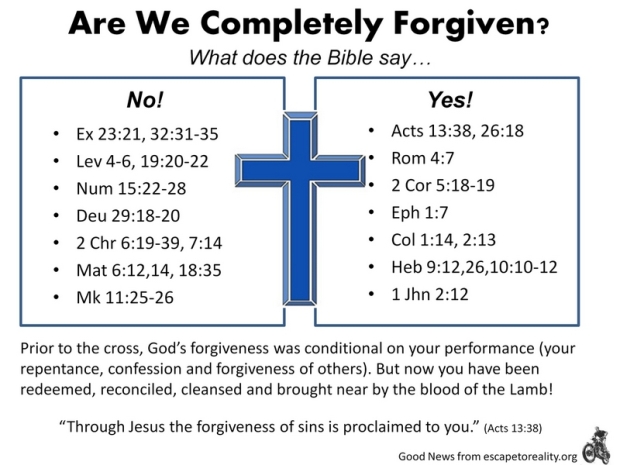
The reason why forgiveness is a done deal and salvation is not, is because forgiveness is a game that requires only one player. God doesn’t need your permission to forgive you. In our puny human minds we find this hard to grasp because we are not natural forgivers. We keep long records of wrong done to us. But God is not like us. He loves us with an unconditional love. He forgives us without any regard for our behavior and in accordance with the riches of His grace (Eph 1:7). Agape-love keeps no record of wrongs which is why God can choose to remember our sins no more. This is wonderful news! When you know His forgiveness, you are empowered to forgive yourself and others.

Yes, we still need to receive His forgiveness just as we need to receive His grace. If you don’t believe that you are forgiven, then you will act like an unforgiven sinner. But we need not ask God to do what He has already done. Forgiveness, along with all the benefits of salvation, comes to us in Christ.

I have written more about forgiveness than just about any other aspect of God’s grace, so if you need further convincing that you are eternally forgiven, start with this post.

You are reconciled; be reconciled

Reconciliation, unlike forgiveness, is a two-player game. Both sides need to play. Consider the husband who wishes to be reconciled with his estranged wife. He loves her with an unconditional love that keeps no record of wrongs. In his mind there is no hurt or offense that has not been forgiven and forgotten. So in his love he has come to the table of reconciliation declaring that all is well from his side. Would you say they have been reconciled? Well that depends on the wife. Unless she chooses to be reconciled, there is no reconciliation.

Now let’s imagine that the wife is so damaged by an unhappy childhood that she unfairly projects her brokenness onto him. Even though he is a perfect gentleman and beyond reproach, in her mind her husband is an angry and violent man. This is how fallen humanity relates to our loving Father in heaven. Even though God has been unfailingly good to us, in our fallen state we think the worst of Him. We imagine Him to be angry and violent.

For as long as we are separated from the life and love of God by our imagined offenses, are we reconciled? Of course not. If the man in our story went around telling others that he and his wife were reconciled – even as she continued living with another man – they would think he was nuts. Yet this is exactly the message that many are preaching.

Has the world been reconciled to God? Paul’s answer was “Yes and no.” From God’s side, reconciliation is an historical event. “All this is from God, who reconciled us to Himself through Christ…” (2 Cor 5:18). God has come to us with open arms. He holds nothing against us – not our sins, not our past, not anything. “While we were still sinners Christ died for us (Rom 5:8). Glory to God!

However, there is no reconciliation in fact unless we respond to His overtures. Hence Paul’s exhortation, “We implore you on Christ’s behalf: Be reconciled to God” (2 Cor 5:20). God loves the world so much that He came and died for us. His heart yearns for the lost and broken. He does not want an historical reconciliation that is not presently true. He wants His kids!

Those who preach historical reconciliation argue that fallen man’s estrangement is based on a lie. Men fear God needlessly and I agree. God is not angry with us. He really does love us. And it is certainly not wrong to preach that God has reconciled us to Himself through Christ since this is what Paul preached. But with equal passion we must also preach the other side, as Paul also did: We implore you – be reconciled to God.

Are you saved?

I’ve heard some claim that the whole world is saved as if this declaration would somehow cause the unsaved to come to their senses and start acting saved. So far I haven’t seen that happen. The Father loved the prodigal at all points in the story, but he never chased his son into the city telling him “You’re mine! Come home.” If he had, his cries would have fallen on deaf ears. Now the son was the son for the entire story, but separated from his dad he was very much a lost son. He wasn’t “saved” until he turned back and found himself in his father’s embrace.

So is the whole world saved or isn’t it? Well if the answer is yes, then why are there so many scriptures indicating that God wants us to be saved (1 Tim 2:4) and that He now commands people everywhere to repent (Acts 17:30) and believe in the name of His Son (1 Joh 3:23) in order to be saved (Mk 16:16), etc. By my count there more than two dozen scriptures specifically exhorting people to be saved and literally hundreds more exhorting them to repent, believe, receive, have faith, trust in God, etc.

As far as I can tell, there is not one verse in the Bible that categorically says all humanity was saved at the cross. Certainly, Jesus has provided for our salvation – His is a finished work. Certainly it is the Father’s will that all should be saved and that none should perish. But His is not the only will in the equation. It takes two people to make a relationship and this is why the New Testament writers repeatedly say that all are not saved. I don’t have time to delve deeper here, but if you’re interested or are wondering about a particular scripture, I encourage you to check out my easy-to-read study notes.

So what?

Does it really matter if we tell unbelievers that they were reconciled and saved 2000 years ago? It surely does! I have heard those who preach historical reconciliation say, “Jesus has established a relationship with all of us.” This is simply not true. Although He surely desires it, Jesus has no relationship with those who are “darkened in their understanding and separated from the life of God” (Eph 4:18). The light of men has come into the world but some men prefer the darkness.

If Jesus had a relationship with everyone, why would Paul exhort us to preach the message of reconciliation? Why would John proclaim “what we have seen and heard so that you may have fellowship with us and the Father and the Son”? What kind of husband are we portraying when we tell sinners that Jesus married them without their knowledge or permission?

Tell a sinner that they are saved and already in a relationship with Jesus and they will look at you sideways. As far as they are concerned, Jesus is not a part of their life. So don’t tell them that He is. Instead tell them that the Lover of their Souls is standing outside their door holding a big bunch of flowers, knocking, and waiting to be invited it. They may hesitate in the belief that God is angry with them or wants them to get their lives sorted out before they come home, but it’s not true! Their heavenly Father longs for them with unconditional love and eternal forgiveness in His heart. He has already shown us His love through the cross and countless other ways. Now He waits to see how we will respond.

Will we stay in the pig pen? Will we come to Him looking for a job? Or will we lose ourselves only to find our true selves in His wonderful embrace?