Saul was in hearty agreement with putting him to death. And on that day a great persecution began against the church in Jerusalem, and they were all scattered throughout the regions of Judea and Samaria, except the apostles.
(a) Saul; see entry for Acts 7:58.
(b) They were all scattered. Jesus told his followers to go to the world after they received power from on high, that is, after Pentecost (Acts 1:8). But most of them didn’t leave Jerusalem until persecution drove them out.
« Better to obey God. Hanging on to their nationial or cultural pride did nothing. Hanging onto their relgious temple and sacrifices did nothing. »
Acts 8:3
But Saul began ravaging the church, entering house after house, and dragging off men and women, he would put them in prison.
(a) Saul; see entry for Acts 7:58.
(b) Dragging off men and women. Saul was an equal-opportunities persecutor responsible for the arrest and execution of Christian men and women.
Why kill women who as recently as the cross had gone largely unnoticed by the authorities? After Pentecost, women stepped up, and those who became partners in ministry became partners in martyrdom. Men and women both were filled with the spirit, spoke in tongues, and proclaimed the word of God boldly (see Acts 2:17-18, 4:31).
Act 4:31 NET
When they had prayed, the place where they were assembled together was shaken, and they were all filled with the Holy Spirit and began to speak the word of God courageously.
John Chrysostom, the Archbishop of Constantinople, said this about the women of the early church: “The women of those days were more spirited than lions, sharing with the Apostles their labors for the Gospel’s sake. In this way they went travelling with them, and also performed all other ministries” (source: “Homily 31 on Romans”).
(c) Prison. In Biblical times, people did not go to prison for years of incarceration but for a short period to await trial. After their trial they were either punished or released. Saul arrested Christians in the expectation that they would be executed (see Acts 9:1, 22:4).
Acts 8:4
Therefore, those who had been scattered went about preaching the word.
(a) Those who had been scattered. Jesus had told his followers to go into all the world after they had received the Holy Spirit (Acts 1:4, 8). Pentecost had come and gone but the Jerusalem Christians stayed put. It took the pressure of persecution to get them out the door.
Acts 8:4
Therefore, those who had been scattered went about preaching the word.
Those who had been scattered. Jesus had told his followers to go into all the world after they had received the Holy Spirit (Acts 1:4, 8). Pentecost had come and gone but the Jerusalem Christians stayed put. It took the pressure of persecution to get them out the door.
Act 1:4
While he was with them, he declared, “Do not leave Jerusalem, but wait there for what my Father promised, which you heard about from me .
Act 1:8
But you will receive power when the Holy Spirit has come upon you, and you will be my witnesses in Jerusalem, and in all Judea and Samaria, and to the farthest parts of the earth.”
Preaching the word. The early Christians preached the word of God (Acts 8:14) which is to say the preached the gospel of Jesus. If they had preached the old covenant law, they would not have been persecuted by the religious leaders. Jesus was the Word of God.
Act 8:14
Now when the apostles in Jerusalem heard that Samaria had accepted the word of God, they sent Peter and John to them.
Acts 8:12
But when they believed Philip preaching the good news about the kingdom of God and the name of Jesus Christ, they were being baptized, men and women alike.
Some they were baptised with water. Somes say they were baptised with the fire of the holy spirit. Some say both. But I say the importance was being baptised in the name of Jesus. Meaning evey thing He accomplished, and in Acts 1 it was the gift of the holy spirit that poured onto everyone that heard.
Acts 8:13
Even Simon himself believed; and after being baptized, he continued on with Philip, and as he observed signs and great miracles taking place, he was constantly amazed.
(a) Simon himself believed. The man who operated in counterfeit signs and wonders marvelled when he saw the real thing. He believed Philip’s message and was water baptized, but he was not filled with the Holy Spirit (see Acts 8:16) and his subsequent actions show he did not have a good grasp of the grace of God (see Acts 8:18).
Signs and great miracles. The gospel of the kingdom is a show and tell gospel (Matt 4:23). When we preach the good news, the Holy Spirit confirms the word with supernatural signs (Mark 16:20).
Mar 16:20
They went out and proclaimed everywhere, while the Lord worked with them and confirmed the word through the accompanying signs.]]
“Vous, les hommes au cou raide, incirconcis de cœur et d’oreilles, vous résistez toujours au Saint-Esprit ; vous faites comme vos pères.
Vous résistez toujours au Saint-Esprit. Dans la nouvelle alliance, la foi est décrite comme un repos (Rom. 4:5, Heb. 4:3), tandis que l’incrédulité est décrite en termes d’actions et de verbes.
Rom 4:5 KJV
Mais à celui qui ne travaille pas, mais qui croit en celui qui justifie l’impie, sa foi est comptée pour justice.
Héb 4, 3 KJV
Car nous qui avons cru, nous entrons dans le repos, comme il l’a dit : Comme je l’ai juré dans ma colère, s’ils entrent dans mon repos ; bien que les œuvres aient été achevées dès la fondation du monde.
L’incrédulité est une œuvre morte. L’incrédulité, c’est résister au Saint-Esprit et s’accrocher à des idoles sans valeur (Actes 7:51, 14:15). L’incrédulité, c’est rejeter Jésus (Jean 3:36) et renier le Seigneur (Jude 1:4). C’est repousser la parole de Dieu et se juger indigne de la vie (Actes 13:46). C’est supprimer la vérité (Rom. 1:18) et prendre plaisir à la méchanceté (2 Th. 2:12). C’est se détourner (Héb. 12:25), s’égarer (2 Pi. 2:15), et fouler aux pieds le Fils de Dieu (Héb. 10:29).
Act 14:15 NASB
et disant : “Hommes, pourquoi faites-vous ces choses ? Nous aussi, nous sommes des hommes de même nature que vous, et nous vous annonçons l’Évangile, pour que vous vous convertissiez de ces choses inutiles à un Dieu vivant, qui a fait le ciel, la terre et la mer, et tout ce qui s’y trouve.
Jn 3:36 NET
Celui qui croit au Fils a la vie éternelle. Celui qui rejette le Fils ne verra pas la vie, mais la colère de Dieu demeure sur lui.
Act 13:46
Paul et Barnabas répondirent courageusement : “Il fallait d’abord vous annoncer la parole de Dieu. Puisque vous la rejetez et que vous ne vous estimez pas dignes de la vie éternelle, nous nous tournons vers les païens.
Rm 1,18
Car la colère de Dieu se révèle du ciel contre toute impiété et toute injustice des hommes qui suppriment la vérité par leur injustice,
Héb 10:29 NET
Quel plus grand châtiment pensez-vous que mérite cette personne qui méprise le Fils de Dieu, qui profane le sang de l’alliance qui l’a rendu saint, et qui insulte l’Esprit de grâce ?
________________________________________
Actes 7:52 KJV
“Lequel des prophètes vos pères n’ont-ils pas persécuté ? Ils ont tué ceux qui avaient annoncé la venue du Juste, dont vous êtes maintenant devenus les traîtres et les meurtriers ;
Le Juste. Jésus-Christ est le Juste et le Rameau vertueux dont parlent les prophètes (Is. 24:16, 53:11, Jer. 23:5, 33:15). Tout comme Jésus est la Parole faite chair, la Vérité vivante et la personnification de la grâce du Père (Jean 1:14, 14:6), il est l’incarnation de la justice de Dieu.
Es 53,11
Après avoir souffert, il réfléchira à son œuvre, il sera satisfait quand il comprendra ce qu’il a fait. “Mon serviteur acquittera beaucoup de gens, car il a porté leurs péchés.
Jn 14,6
Jésus répondit : “Je suis le chemin, la vérité et la vie. Personne ne vient au Père que par moi.
Mais ces hommes rejettent le seul chemin vers le Dieu qu’ils disaient servir.
Act 7:54 KJV
Quand ils entendirent ces choses, ils devinrent furieux et grincèrent des dents contre lui.
Act 7:55
Mais Étienne, rempli de l’Esprit Saint, regarda attentivement vers le ciel et vit la gloire de Dieu, et Jésus debout à la droite de Dieu.
Étienne était rempli de l’Esprit Saint et d’amour pour ses oppresseurs, y compris Saul qui allait devenir le grand apôtre Paul. Le Sanhédrin, le tribunal juif chargé de statuer sur les décisions religieuses, décide de rejeter Jésus et l’Évangile. Étienne ne pouvait faire autrement que de se soumettre à l’appel de l’Esprit Saint en lui et de continuer à être un témoin ou un “martyr”, même jusqu’à la fin de sa vie.
Dieu a donné à Etienne la révélation de Jésus debout pour lui, l’encourageant et l’accueillant dans la félicité éternelle. Aucune perte, mais tout à gagner. Ils ont donc tué Étienne, mais pas l’esprit de Paul.
Actes 7:58
Lorsqu’ils l’eurent chassé de la ville, ils commencèrent à le lapider ; et les témoins déposèrent leurs robes aux pieds d’un jeune homme nommé Saul.
(a) La lapidation. Le Sanhédrin avait l’autorité de mettre à mort des personnes pour des crimes religieux. Ils ont lapidé Étienne (Actes 7:58), ils ont discuté de la lapidation d’une femme prise en adultère (Jean 8:5), et ils avaient déjà essayé de lapider Jésus (Jean 10:31).
(b) Un jeune homme. Le mot “jeune” peut désigner toute personne âgée de moins de 40 ans. Saul était probablement âgé d’une trentaine d’années.
(c) Saul. C’est la première mention de l’apôtre le plus influent du Nouveau Testament. Avant d’être connu sous le nom de Paul, l’écrivain d’épîtres qui a implanté des églises, Saul était un pharisien zélé qui chassait les chrétiens (Actes 22:4). Saul était un terroriste religieux extrêmement dangereux qui “persécutait jusqu’à la mort les adeptes de cette voie, arrêtant hommes et femmes et les jetant en prison” (Actes 22:4).
Après sa conversion spectaculaire, ce champion du péché est devenu un champion de l’Évangile. Paul et quatre autres auteurs ont écrit collectivement près de la moitié de la Bible entière. (Les autres sont Moïse, Esdras, Luc et Jérémie).
Saul n’a pas changé son nom en Paul mais était plutôt connu sous les deux noms. “Saul, qui était aussi connu sous le nom de Paul” (Actes 13:9). En tant que Juif zélé, il portait son nom hébreu Saul ; en tant qu’apôtre des Gentils, il portait son nom romain Paul.
“You men who are stiff-necked and uncircumcised in heart and ears are always resisting the Holy Spirit; you are doing just as your fathers did.
Always resisting the Holy Spirit. In the new covenant, faith is described as a rest (Rom. 4:5, Heb. 4:3), while unbelief is described as in terms of actions and verbs.
But to him that worketh not, but believeth on him that justifieth the ungodly, his faith is counted for righteousness.
Heb 4:3 KJV
For we which have believed do enter into rest, as he said, As I have sworn in my wrath, if they shall enter into my rest: although the works were finished from the foundation of the world.
Unbelief is a dead work. Unbelief is resisting the Holy Spirit and clinging to worthless idols (Acts 7:51, 14:15). Unbelief is rejecting Jesus (John 3:36) and denying the Lord (Jude 1:4). It’s thrusting away the word of God and judging yourself unworthy of life (Acts 13:46). It’s suppressing the truth (Rom. 1:18) and delighting in wickedness (2 Th. 2:12). It’s turning away (Heb. 12:25), going astray (2 Pet. 2:15), and trampling the Son of God underfoot (Heb. 10:29).
Act 14:15 NASB
and saying, “Men, why are you doing these things? We are also men, of the same nature as you, preaching the gospel to you, to turn from these [fn]useless things to a living God, who MADE THE HEAVEN AND THE EARTH AND THE SEA, AND EVERYTHING THAT IS IN THEM.
Jhn 3:36 NET
The one who believes in the Son has eternal life. The one who rejects the Son will not see life, but God’s wrath remains on him.
Act 13:46
Both Paul and Barnabas replied courageously, “It was necessary to speak the word of God to you first. Since you reject it and do not consider yourselves worthy of eternal life, we are turning to the Gentiles.
Rom 1:18
For the wrath of God is revealed from heaven against all ungodliness and unrighteousness of people who suppress the truth by their unrighteousness,
Heb 10:29 NET
How much greater punishment do you think that person deserves who has contempt for the Son of God, and profanes the blood of the covenant that made him holy, and insults the Spirit of grace?
Acts 7:52 KJV
“Which one of the prophets did your fathers not persecute? They killed those who had previously announced the coming of the Righteous One, whose betrayers and murderers you have now become;
Righteous One. Jesus Christ is the Righteous One and the Righteous Branch spoken of by the prophets (Is. 24:16, 53:11, Jer. 23:5, 33:15). Just as Jesus is the Word made flesh, the living Truth, and the personification of the Father’s grace (John 1:14, 14:6), he is the embodiment of God’s righteousness.
Isa 53:11
Having suffered, he will reflect on his work, he will be satisfied when he understands what he has done. “My servant will acquit many, for he carried their sins.
Jhn 14:6
Jesus replied, “I am the way, and the truth, and the life. No one comes to the Father except through me.
But these men reject the only way to the God they said they were serving.
Act 7:54 KJV
When they heard these things, they became furious and ground their teeth at him.
Act 7:55
But Stephen, full of the Holy Spirit, looked intently toward heaven and saw the glory of God, and Jesus standing at the right hand of God.
Stephen was full of the Holy Spirit and Love for His oppressors including Saul who would become the great apostle Paul. The Sanhedrin, the ruling Jewish court for their religious decision decide to reject Jesus and the Gospel. Stephen could do no more than to submit to the call of the Holy spirit in him and continue to be a witness or “martyr” even to the end of his life.
God gave Stephen revelation of Jesus standing for Him cheering Stephen and welcoming him to Eternal bliss. No loss but everything to gain. So they killed Stephen, but not the spirit in Paul.
Acts 7:58
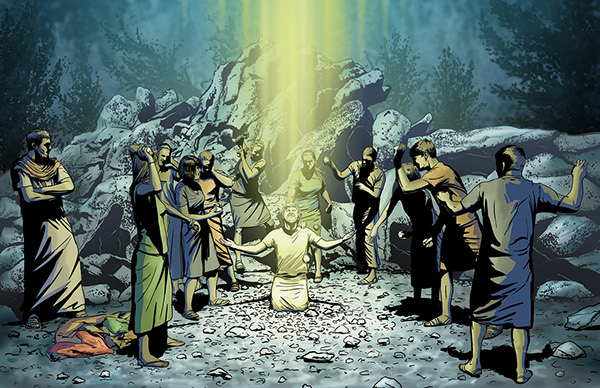
When they had driven him out of the city, they began stoning him; and the witnesses laid aside their robes at the feet of a young man named Saul.
(a) Stoning him. The Sanhedrin had the authority to put people to death for religious crimes. They stoned Stephen (Acts 7:58), they discussed stoning a woman caught in adultery (John 8:5), and they had tried before to stone Jesus (John 10:31).
(b) A young man. The word for young can mean anyone under the age of 40. Saul was probably in his thirties.
(c) Saul. This is the first mention of the most influential apostle in the New Testament. Before he became known as Paul the church-planting writer of epistles, Saul was a zealous Pharisee who hunted Christians (Acts 22:4). Saul was an extremely dangerous religious terrorist who “persecuted the followers of this Way to their death, arresting both men and women and throwing them into prison” (Acts 22:4).
After his dramatic conversion, this champion sinner became a champion of the gospel. Paul and four other authors collectively wrote almost half of the entire Bible. (The others are Moses, Ezra, Luke, and Jeremiah.)
Saul did not change his name to Paul but was rather known by both names. “Saul, who was also known as Paul” (Acts 13:9). As a zealous Jew he went by his Hebrew name Saul; as an apostle to the Gentiles he went by his Roman name Paul.
Il semble excentrique de dire que je suis né dans un culte satanique.
Mais, c’est l’influence la plus importante dans ma vie.
J’ai été élevé à la télévision et maintenant sur Internet.
Pourtant, je ne pouvais pas le voir car, comme la plupart des gens, j’étais possédé par des satanistes.
Nous ne pouvons pas nous voir nous-mêmes.
Je ne parle pas d’une secte mineure.
Je parle de la société dans son ensemble. Le World Wide Web. Wor
La société a été intronisée dans un culte satanique, le cabalisme juif, c’est-à-dire la franc-maçonnerie, le communisme, le matérialisme.
Notre caractère et notre perception ont été déterminés par des satanistes, généralement des juifs cabalistes et des francs-maçons.
MON EXEMPLE
Dans ma jeunesse, la première chose que la société m’a enseignée est que DIEU EST MORT.
Le Créateur devrait être vénéré et célébré. Il devrait être notre centre d’intérêt constant.
Au lieu de cela, comme un squatter, il a été expulsé de sa création.
J’ai appris la liturgie de l’Existentialisme. “L’homme doit créer son propre sens car il n’y a pas de sens inhérent à la vie.”
Quelle connerie ! La vie a un sens inhérent. La vie est un miracle.
On a hérité d’un temple mais on choisit d’habiter la cave.
Ça dépasse l’entendement ! Mais bon, c’est le satanisme (communisme) pour vous.
Citations-sur-le-sexe-Woody-Allen-658×570.jpg
Pas des juifs chrétiens, mais (des juifs cabalistes qui intronisent la société dans leur culte sexuel)
La deuxième chose que j’ai apprise est que le rapport sexuel est l’expérience la plus élevée que la vie puisse offrir.
C’est mystique !
Alors, idiot crédule, je suis devenu accro au sexe.
J’ai gaspillé ma vie à courir après des chimères, le sexe et l’amour romantique.
Vous ne pouvez jamais obtenir une illusion.
La troisième chose que j’ai apprise, c’est de courir après l’argent. Alors, idiot crédule, j’ai développé une addiction au jeu.
Le monde est maintenant un casino géant où des milliards de personnes placent des paris en temps réel.
Idiot effacé, j’ai stupidement supposé que la société avait une sorte de sagesse, ou d’autorité morale.
La quatrième chose était la supposition subtile que les êtres humains sont ce qui se rapproche le plus de Dieu, qu’ils sont infiniment intéressants alors qu’en fait la plupart sont plutôt stupides, prétentieux et ennuyeux.
Obtenir un doctorat en littérature anglaise, c’était comme lire des entrailles, analyser les fautes de frappe dans les “grandes œuvres d’art”.
Elles détenaient une certaine “vérité” ésotérique.
C’était “l’humanisme”.
Le post-modernisme est encore plus stupide. Il n’y a pas de vérité objective. Tout est perception.
Conneries. C’est triste.
Le système éducatif moderne est un endoctrinement dans le cabalisme (communisme).
J’ai passé trop de temps à regarder les autres, au lieu de regarder Dieu, la voie de mon développement personnel.
J’ai été déformé par ces shibboleths “modernes” (c’est-à-dire satanistes).
Déformé, je n’étais plus que l’ombre de ce que j’aurais pu être.
Je souffre encore de cet endoctrinement.
LA PROGRAMMATION CONTINUE
Nous nous noyons dans le porno et les cochonneries.
La société moderne est comme un idiot vieillissant qui regarde les jeunes femmes déballer le même vieux paquet fatigué et prétend qu’il présente encore un certain intérêt.
Les satanistes ont détruit les rôles sociaux honorés d’épouse et de mère et ont transformé les femmes en stars du porno et en putains.
Maintenant que les satanistes ont été démasqués, je vois comment j’ai été corrompu par une société à laquelle je faisais naïvement confiance.
Et j’essaie de retrouver ma forme humaine.
Petit à petit, la société va aussi se réveiller.
Je me suis réveillé et je suis vivant en Christ mais mort à ce monde !
It seems outlandish to say I was born into a satanic cult.
But, it’s the most important influence in my life.
I was brought up on TV and now Internet.
Yet, I couldn’t see it because, like most people, I was satanically possessed.
We can’t see ourselves.
I’m not talking some minor sect.
I’m talking about society as a whole. The World wide web. Wor
Society has been inducted into a Satanic cult, Jewish Cabalism, i.e. Freemasonry, Communism, materialism.
Our character and perception were determined by Satanists, usually Cabalist Jews and Freemasons.
MY EXAMPLE
As a youth, the first thing society taught me was GOD IS DEAD.
The Creator should be worshipped and celebrated. He should be our constant focus.
Instead, like a squatter, He’s been evicted from His Creation.
I learned the liturgy of Existentialism. “Man has to create his own meaning because there is no inherent meaning in life.”
What utter CRAP! Life has inherent meaning. Life is a miracle.
We inherited a temple but choose to inhabit the cellar.
It beggars belief! But hey, that’s Satanism (Communism) for you.
Quotes-about-Sex-Woody-Allen-658×570.jpg
Not Christian Jews but (Cabalist Jews inducted society into their sex cult)
The second thing I learned is that sexual intercourse is the highest experience life has to offer.
It’s mystical!
So, gullible fool, I became a sex addict.
I wasted my life chasing chimeras, sex and romantic love.
You can never obtain an illusion.
The third thing I learned was to chase the buck. So, gullible fool I developed a gambling habit.
The world now is a giant casino where billions of people place bets in real time.
Self effacing idiot, I stupidly assumed society had some kind of wisdom, or moral authority.
The fourth thing was the subtle assumption that human beings are the closest thing to God, infinitely interesting when in fact most are pretty stupid, pretentious and boring.
Getting a PhD in English Literature was like reading entrails, parsing typos in “Great works of art.”
They held some esoteric “truth”.
This was “humanism.”
Post modernism is even stupider. There is no objective truth. Everything is perception.
Bull shit. So sad.
The modern education system is an indoctrination into Cabalism (Communism.)
I spent too much time looking up to other people, instead of looking up to God, the path of my self development.
I was deformed by these “modern” (i.e. satanist) shibboleths.
Twisted out of shape, I was a shadow of what I could have been.
I am still suffering from this indoctrination.
THE PROGRAMMING CONTINUES
We are drowning in porn and smut.
Modern society is like a doddering idiot watching young women unwrap the same tired old package and pretending it still holds some interest.
Satanists have destroyed the honored social roles of wife and motherhood and turned women into porn stars and whores.
Now that the Satanists have been unmasked, I see how I was corrupted by a society I naively trusted.
And try to regain my human shape.
Gradually, society will also awaken.
I have awoken and I am alive in Christ but dead to this world!
Here’s an obscure prophecy about Jesus that probably affects you more than you know:
“Behold, I am going to send my messenger, and he will clear the way before me. And the Lord, whom you seek, will suddenly come to his temple; and the messenger of the covenant, in whom you delight, behold, he is coming,” says the Lord of hosts. (Malachi 3:1)
For the Jewish exiles who had returned to Jerusalem and rebuilt the temple, this would have been an exciting prophecy. “The Lord is coming to his temple!” But when was this prophecy fulfilled? This is the $64,000 question!
Who’s it about?
Two people are mentioned in the prophecy: The messenger who clears the way is John the Baptist (see Matthew 11:10), and the messenger of the covenant or the Lord who follows him is Jesus.
According to the prophet, the latter follows the former suddenly, like a two-punch combination. First one, then the other. And this is what we see in the gospels; first John then Jesus.
Did Jesus go to the temple?
Many times. You probably know Jesus went to the temple to overturn tables and drive out cattle. But did you also know that Jesus made it his habit to teach in the temple courts?
Now during the day he was teaching in the temple… and all the people would get up early in the morning to come to him in the temple to listen to him. (Luke 21:37-38)
Jesus, the messenger of the new covenant, wanted the Jews to hear him so he went where they congregated:
I have spoken openly to the world; I always taught in synagogues and in the temple, where all the Jews come together; and I spoke nothing in secret. (John 18:20)
By coming to the temple to preach the good news, Jesus fulfilled the words of the prophet. The End.
Mr. Preterist speaks
“No, you’ve missed something there, Paul. Malachi 3 speaks of Jesus coming to the temple in judgment. This prophecy is about AD70 when Jesus came to judge the Jews and burn their temple.”
That’s a serious accusation. We’d better take a closer look.
But who can endure the day of his coming? And who can stand when he appears? For he is like a refiner’s fire and like fullers’ soap. He will sit as a smelter and purifier of silver, and he will purify the sons of Levi and refine them like gold and silver, so that they may present to the Lord offerings in righteousness. (Malachi 3:2-3)
Some believe this refers to the Roman destruction of the temple, but the “Who can stand” phrase comes from the Psalms:
If you, Lord, kept a record of sins, Lord, who could stand? But with you there is forgiveness, so that we can, with reverence, serve you. (Psalm 130:3-4, NIV)
No one can stand before a holy and righteous God. All of us fall short of the lofty standard and we all need the forgiveness that Christ freely offers. The problem was the religious leaders didn’t see it. They thought they could stand on their own moral performance, which is why Jesus was often so hard on them. He pummeled them with the law so that their boasting mouths might be silenced. He was tough on them so they might see their need for grace.
What about the fire and soap?
The refiner’s fire and fuller’s soap is not a reference to Romans burning Jerusalem, but Jesus dividing the pure from the dross and cleansing the sinner. The prophet said “he will purify the sons of Levi,” and he did this by offering himself on the cross:
(Jesus) gave himself for us to redeem us from every lawless deed, and to purify for himself a people for his own possession, zealous for good deeds. (Titus 2:14)
“But Malachi 3:5 says the Lord will draw near for judgment.”
And judgment is what happened whenever people encountered the Lord: Some believed him, others rejected him. That’s judgment.
He who believes in him is not judged; he who does not believe has been judged already, (John 3:18)
Judgment is not merely something that happens in the distant future. Judgment Day is a future manifestation of a present reality.
For judgment I came into this world. (John 9:39)
Jesus wasn’t saying, “I’m here to judge y’all,” for he also said “I pass judgment on no one” (John 8:15). But judgment is what happens when we respond to Jesus Christ. We judge, we decide, whether Jesus is who he says he is.
No Romans needed
Put it altogether and we see that Malachi’s prophecy of the Lord coming to the temple to refine, cleanse and judge was fulfilled during Christ’s time on earth. Jesus went to the temple because he wanted the sons of Levi (the priests) to hear the good news of the kingdom. Sadly, many of them rejected his message which is why, on his last visit, he pronounced the woeful consequences of their choice (see Matthew 23).
But his mission to purify the sons of Levi was not a failure. We have this idea that the priests all hated Jesus, but the fact is he won many:
The word of God kept on spreading; and the number of the disciples continued to increase greatly in Jerusalem, and a great many of the priests were becoming obedient to the faith. (Act 6:7)
As a result of the Lord coming to the temple many sons of Levi became followers of Christ. (Sidebar: One of the sons of Levi became instrumental in releasing the Apostle Paul into ministry. His name was Barnabas (Acts 4:36).)
Then the offering of Judah and Jerusalem will be pleasing to the Lord as in the days of old and as in former years. (Malachi 3:4)
Judah and Jerusalem were not made pleasing to the Lord on account of a Roman massacre. They were made pleasing by Jesus. Before Jesus came along, Jerusalem was the center of self-righteous religion. It was a hotbed of hypocrisy. But Jesus turned it into the birthplace of his church and ground zero for his gospel.
So what?
Why does this matter? It matters because there are some who use the words of Malachi to rewrite history and blame God for the massacre of the Jews in AD70. This is bad news because if God judged the same Jews that Jesus forgave then the Father and Son are a house divided. It means the gospel of Jesus is not as good as you think it is.
But the good news is that Jesus fulfilled Malachi’s prophecy by loving the sons of Levi. He did not slaughter them with Roman swords but he went to the cross for them and for us.
This is the version of history recorded in scripture. This is the good news story worth telling.
Posté le 15 novembre 2016 par Paul Ellis // 13 commentaires
temple_ad70
Voici une obscure prophétie sur Jésus qui vous touche probablement plus que vous ne le pensez :
” Voici, je vais envoyer mon messager, et il défrichera le chemin devant moi. Et le Seigneur, que vous cherchez, viendra soudain dans son temple ; et le messager de l’alliance, en qui vous prenez plaisir, voici qu’il vient,” dit le Seigneur des armées. (Malachie 3:1)
Pour les exilés juifs qui étaient revenus à Jérusalem et avaient reconstruit le temple, cette prophétie devait être passionnante. “Le Seigneur vient dans son temple !” Mais quand cette prophétie s’est-elle accomplie ? C’est la question à 64 000 $ !
De qui s’agit-il ?
Deux personnes sont mentionnées dans la prophétie : Le messager qui ouvre la voie est Jean le Baptiste (voir Matthieu 11:10), et le messager de l’alliance ou le Seigneur qui le suit est Jésus.
Selon le prophète, ce dernier suit le premier de manière soudaine, comme une combinaison de deux coups de poing. D’abord l’un, puis l’autre. Et c’est ce que nous voyons dans les évangiles : d’abord Jean, puis Jésus.
Jésus est-il allé au temple ?
Plusieurs fois. Vous savez probablement que Jésus est allé au temple pour renverser les tables et chasser le bétail. Mais savez-vous aussi que Jésus avait l’habitude d’enseigner dans les parvis du temple ?
Pendant la journée, il enseignait dans le temple… et tous les gens se levaient tôt le matin pour venir l’écouter dans le temple. (Luc 21:37-38)
Jésus, le messager de la nouvelle alliance, voulait que les Juifs l’entendent, alors il est allé là où ils se rassemblaient :
J’ai parlé ouvertement au monde ; j’ai toujours enseigné dans les synagogues et dans le temple, où tous les Juifs s’assemblent ; et je n’ai rien dit en secret. (Jean 18:20)
En venant au temple pour prêcher la bonne nouvelle, Jésus a accompli les paroles du prophète. La fin.
M. Prétériste parle
“Non, vous avez manqué quelque chose, Paul. Malachie 3 parle de Jésus venant au temple en jugement. Cette prophétie concerne l’an 70 de notre ère, lorsque Jésus est venu juger les Juifs et brûler leur temple.”
C’est une accusation sérieuse. Nous ferions mieux d’y regarder de plus près.
Mais qui peut supporter le jour de sa venue ? Et qui pourra se tenir debout quand il apparaîtra ? Car il est comme le feu d’un raffineur et comme le savon d’un foulon. Il s’assiéra comme un fondeur et un purificateur d’argent, et il purifiera les fils de Lévi et les affinera comme l’or et l’argent, afin qu’ils présentent au Seigneur des offrandes dans la justice. (Malachie 3:2-3)
Certains croient que cela fait référence à la destruction romaine du temple, mais la phrase “Qui peut tenir debout” vient des Psaumes :
Si toi, Seigneur, tu tenais un registre des péchés, Seigneur, qui pourrait subsister ? Mais avec toi, il y a le pardon, afin que nous puissions, avec respect, te servir. (Psaume 130:3-4, NIV)
Personne ne peut se tenir devant un Dieu saint et juste. Nous ne sommes pas tous à la hauteur de la norme élevée et nous avons tous besoin du pardon que le Christ offre gratuitement. Le problème est que les chefs religieux ne l’ont pas vu. Ils pensaient pouvoir s’appuyer sur leurs propres performances morales, c’est pourquoi Jésus était souvent si dur avec eux. Il les a assommés avec la loi afin de faire taire leurs fanfaronnades. Il était dur avec eux pour qu’ils voient leur besoin de grâce.
Le feu du raffineur et le savon du foulon ne font pas référence aux Romains brûlant Jérusalem, mais à Jésus séparant le pur du sale et purifiant le pécheur. Le prophète a dit “il purifiera les fils de Lévi”, et il a fait cela en s’offrant sur la croix :
(Jésus) s’est donné lui-même pour nous, afin de nous racheter de toute action illicite, et de purifier pour lui-même un peuple à lui, zélé pour les bonnes actions. (Tite 2:14)
“Mais Malachie 3:5 dit que le Seigneur s’approchera pour le jugement.”
Et le jugement est ce qui s’est produit chaque fois que les gens ont rencontré le Seigneur : Certains l’ont cru, d’autres l’ont rejeté. C’est ça le jugement.
Celui qui croit en lui n’est pas jugé ; celui qui ne croit pas a déjà été jugé (Jean 3:18).
Le jugement n’est pas simplement quelque chose qui se produit dans un avenir lointain. Le jour du jugement est une manifestation future d’une réalité présente.
C’est pour le jugement que je suis venu dans ce monde. (Jean 9:39)
Jésus ne disait pas “Je suis ici pour vous juger”, car il a également dit “Je ne juge personne” (Jean 8:15). Mais le jugement est ce qui se produit lorsque nous répondons à Jésus-Christ. Nous jugeons, nous décidons, si Jésus est bien celui qu’il dit être.
Pas besoin de Romains
Si l’on met tout cela bout à bout, on constate que la prophétie de Malachie, selon laquelle le Seigneur viendrait au temple pour raffiner, purifier et juger, s’est accomplie pendant le séjour du Christ sur terre. Jésus est allé au temple parce qu’il voulait que les fils de Lévi (les prêtres) entendent la bonne nouvelle du royaume. Malheureusement, beaucoup d’entre eux ont rejeté son message, c’est pourquoi, lors de sa dernière visite, il a prononcé les conséquences malheureuses de leur choix (voir Matthieu 23).
Mais sa mission de purifier les fils de Lévi n’a pas été un échec. Nous avons cette idée que les prêtres détestaient tous Jésus, mais le fait est qu’il en a gagné beaucoup :
La parole de Dieu continuait à se répandre ; le nombre des disciples continuait à augmenter considérablement à Jérusalem, et un grand nombre de prêtres devenaient dociles à la foi. (Actes 6:7)
À la suite de la venue du Seigneur au temple, de nombreux fils de Lévi sont devenus des disciples du Christ. (Encadré : L’un des fils de Lévi a joué un rôle déterminant dans la libération de l’apôtre Paul dans son ministère. Il s’appelait Barnabé (Actes 4:36)).
Alors l’offrande de Juda et de Jérusalem sera agréable à l’Éternel comme aux jours d’autrefois et comme dans les années passées. (Malachie 3:4)
Juda et Jérusalem n’ont pas été rendus agréables au Seigneur à cause d’un massacre romain. C’est Jésus qui les a rendues agréables. Avant l’arrivée de Jésus, Jérusalem était le centre de la religion moralisatrice. C’était un foyer d’hypocrisie. Mais Jésus en a fait le lieu de naissance de son Église et le point de départ de son Évangile.
Et alors ?
Pourquoi cela est-il important ? Parce que certains utilisent les paroles de Malachie pour réécrire l’histoire et rendre Dieu responsable du massacre des Juifs en 70 après Jésus-Christ. C’est une mauvaise nouvelle car si Dieu a jugé les mêmes Juifs que Jésus a pardonnés, alors le Père et le Fils sont une maison divisée. Cela signifie que l’Évangile de Jésus n’est pas aussi bon que vous le pensez.
Mais la bonne nouvelle est que Jésus a accompli la prophétie de Malachie en aimant les fils de Lévi. Il ne les a pas massacrés avec des épées romaines, mais il est allé à la croix pour eux et pour nous.
Telle est la version de l’histoire relatée dans les Écritures. C’est l’histoire de la bonne nouvelle qui vaut la peine d’être racontée.
I have two passions besides the Truth. Both deal l with the beauty of Gods nature. A wiseman noticed that the closer you look at things God created, the more perfect they get but the opposite is trur for everything mans gets his hands into.
Take for example a pretty penny and then use a microscope and will see there are imperfections galore, like scratches, impurities and holes that where not in man’s design. Then the more powerful the lens you use, the greater are imperfection. But now if zoom in with optical scope into Gods creation. Mineral kingdom , Vegetal or Animal it is perfect.
The closer look the more order and perfection you see. You will find crystals or cells all following logical order with repeating laws. Then go deep to the molecules that make crystal lattices or determine the dna of your mortal coil, it is still perfect. And go deeper, atoms, orbitals, bond and molecules, to subatomic and beyond you will see they all spin with certain God ordained rules. As well the megaverse and the order of the stars.
Well I was doing some scuba diving in Mexico in 2019 and I will share some photos sometime.
But lately I have been using my man cave for a photography studio and going through a lot of macrophotos with a helicon stacking program
I want to share why i chose the name truthprospector. The reason is I love to prospect for true things. The best are in Gods creation untouched by the human hand. But best of all is the Word of the Creator, which is The Truth and His name is Jesus.
King Beaver Open Pit, Thetford Mines Quebec specimens. 1) brown calcite scalehedral xls whych in the 3rd photo fluoresce under short wave UV light. 2) a nice smokey quartz xl 3) the 1st specimen under sw uv light
polished fossil containing chalcedoy from Sunset beach Cape May NJ
If ever a Christian has moral issues with how God is sometimes portrayed in the Old Testament, theological gatekeepers will fling the term “Marcionism” or “Marcionite” to dismiss such questioning as heresy. Knowingly or unknowingly, it is used as a strawman argument to villainize someone who notices discrepancies in the Bible. Accusers are often fundamentalists or inerrantists, but in any case, they wish to defend Scripture from their point of view.
Is Rival Nations a Marcionite? Does Rival Nations support Marcionism? What does Rival Nations think about Marcion of Sinope?
THE MARCION PROBLEM
Marcion of Sinope was a man who lived from AD 80-160 in the Roman empire. He is responsible for the first New Testament canon to ever exist. While not considered an early Church father himself, he is likely ultimately responsible for spurring on the creation of the Apostles’ Creed and the Catholic canon of Scripture. Marcion read the Hebrew scriptures (the Old Testament) and was appalled by how sometimes God was portrayed as a violent, vindictive, spiteful, genocidal god. He wondered how this god could be compatible with the always loving, caring, compassionate, merciful, and graceful god he saw in Jesus Christ. Many, many, many Christians and non-Christians notice the same thing. Many Christians seek to understand and explain the solution to this problem. That is what Marcion of Sinope did—he just went a little too far. Okay, he went a lot too far.
It doesn’t take a Bible scholar to see that the God of the Old Testament and the God of the New Testament often look very different. If you’ve read the Bible, you’ve seen this. Marcion saw this. But Marcion became Christianity’s first heretic for how he reconciled this problem. Marcion decided that the God of the Old Testament, Yahweh, and the God of the New Testament, Jesus’s Father, weren’t even the same god. He figured that Yahweh was responsible for creation, but that he wasn’t Christ’s father but instead he was a demon. Because of this, Marcion threw out the entire Old Testament, rejecting it as Scripture. He created his own canon of scripture that only included ten Pauline epistles and his modified version of Luke.
Marcion didn’t stop there. He also had some pretty heretical views on Jesus. Marcion believed that Jesus never had a physical body or that he was ever born at all. He rejected the belief in Jesus returning, of a coming judgment, and the bodily resurrection of humankind. All of Marcion’s beliefs are outside of Christian orthodoxy and are rejected by Rival Nations.
LITERARILY INSTEAD OF LITERALLY
The term “Marcionite” is often used to describe people who find solutions to the discrepancy of God’s violent nature in the Old Testament and God’s nonviolent nature in the New Testament. Most often, the slander isn’t even made against people who actually believe what Marcion believed; rather, it is just used as a strawman to dismiss the argument. But many Christians struggle with what Marcion struggled with, and better solutions have been found.
Several early Church fathers, including Origen and Tertullian1, wrote against Marcion’s beliefs. They took issue with Marcion for the root of his issues: taking the Old Testament too literally. These early Church fathers didn’t interpret the whole Old Testament literally, and interpreted much of it allegorically, especially when related to the record of violent acts.
The early Church fathers agreed with Marcion that Jesus shows us the exact representation of God and that in comparison, no one has ever seen God (Hebrews 1:1-3, John 1:18). That, by itself, is completely orthodox and central to Christianity. But Origen believed it was sinful for Marcion to interpret the Old Testament’s violent stories as literal, the root cause of him throwing out the Hebrew Scriptures. Origen remarks about Marcion’s downfall, “Holy Scripture is not understood by [Marcion] according to its spiritual, but according to its literal meaning.”2 Would strict literalists who fling around the accusation of “Marcionism” apply that insult to all the church fathers who interpreted portions of the Hebrew scriptures allegorically? Unlikely.
READING THROUGH THE CROSS
Interpreting the Old Testament through the lens of Jesus and the Cross is what makes Christianity different than Judaism. Interpreting the Old Testament differently than a modern Jewish Rabbinic scholar doesn’t make one a Marcionite. Christians start all their theology and interpretive hermeneutics at the Cross and go from there, not the other way around. This is why Paul says that he resolves to know nothing except Christ crucified (1 Corinthians 2:2).
Interpreting the Hebrew Bible in the light of Christ is Christianity. Throwing away the Hebrew Bible is Marcionism.” -Brian Zahnd
Christians don’t throw out the Old Testament just because its authors sometimes misunderstood God. All of the Old Testament is inspired by God (2 Timothy 3:16 NRSV), and it records the journey of God’s people as they struggle and strive to understand him. But we know today that all of the authors of the Hebrew scriptures lacked what the authors of the New Testament had—Jesus Christ. To say that Jesus changed nothing about how the Old Testament should be interpreted is to ignore a major reason why God came in the flesh. Jesus caused Paul to rethink everything he had ever thought about the Hebrew scriptures. Jesus should cause us to rethink everything about the Old Testament and view everything we read through the lens of the Cross.
Unlike Marcion, Rival Nations believes that Yahweh and the Father are the same person. Unlike Marcion, Rival Nations believes that Yahweh is Christ’s father. Unlike Marcion, Rival Nations believes that the Old Testament is inspired by God. Unlike Marcion, Rival Nations believes that the Hebrew scriptures are part of the Biblical canon. Unlike Marcion, Rival Nations believes that Jesus came in bodily form and will resurrect the dead in bodily form one day. Unlike Marcion, Rival Nations believes that the Old Testament should be interpreted through Christ crucified.
I Believe we saw man leave God Totally form the Garden to be without God. Violence and hate and war was the lack of understanding. It took all those thousand of years to bring man back to understand God is LOVE and we saw GOD in His own SON
Jesus appeared on the scene, offering a new way of life, a way of peace. He called his way of life the Kingdom of God. He taught us that we are to pray and work for this Kingdom to come to earth. He taught us to pray and work for his will to be increasingly done on earth as it is in heaven (Matthew 6:10). Jesus taught that his Kingdom of Peace would start small but would grow to be the biggest Kingdom in the whole world (Mark 4:30-32).
Prior to this view of a doom-obsessed end of the world, the primary belief through Church history was that the world would continue to get better and betteras the Kingdom grew until Jesus returned to vanquish evil entirely. This is what the apostles taught. This is what the early Church taught. No Rapture, no 7-year Tribulation, no Antichrist, no battle of Armageddon, no conflict regarding Israel. And you won’t believe what they thought about the Mark of the Beast.
How did we go from a Gospel of “peace and hope” to a warning of “death and disaster”? How did we go from a Gospel of “the world is getting better” to an idea that “the world is getting worse”? How did we go from a Gospel of “bringing heaven to earth” to an “escape from earth to heaven”? Where did all this come from?
THE INVENTION OF THE DOOM MACHINE
A Rapture, a 7-year Tribulation, and a one-world Anti-Christ leader were all things that no Christian had ever heard of before the Reformation in the 1500s. In his rejection of Catholicism, Martin Luther called the Roman Catholic church the “Whore of Babylon” and the Beast, both references to Rome from the book of Revelation. In England, John Wycliffe, Martin Luther in Germany, John Calvin in France, John Knox in Scotland, Ulrich Zwingli in Switzerland, and countless others, all began preaching that the Pope was the antichrist.1 To counter this new popular belief, in 1585 a Catholic Jesuit priest by the name of Francisco Ribera published a 500-page work that placed Daniel 9:24-27, Matthew 24, and Revelation 4-19 in the distant future.2 Rather than seeing these passages as already fulfilled, now Ribera was saying they were still to be fulfilled in the future.3 This was the first teaching of its kind and was the foundation for modern western evangelical futurist end-times views.4 Historically speaking, this new belief didn’t take off right away.
Ribera’s book was actually lost for hundreds of years until, in 1826 a librarian to the Archbishop of Canterbury rediscovered and published it.5 A man named John Nelson Darby, a British evangelical preacher and founder of the Plymouth Brethren, came across Ribera’s newly resurfaced book and unfortunately took the propaganda seriously. Doom and gloom end-times beliefs kicked back into gear in 1830 in Port Glasgow, Scotland, when fifteen-year-old Margaret MacDonald attended a healing service.6 It was there she was said to have seen a vision of the return of Jesus happening in two stages: Jesus taking Christians from the Earth (eventually called the Rapture) and then returning again years later.7 Prior to this, it was a forgone conclusion that Jesus was only returning one time.
Her story was adopted and amplified by John Nelson Darby. He taught that the world would be getting progressively worse until Jesus came and secretly snatched all the Christians away. This heretical belief admonished an entire generation of Christ-followers who were busy improving society. Darby would go on to invent the idea of “dispensationalism,” which packages several fringe, yet now popular in the West, beliefs about the end-times.
During the 1830s, the Holy Spirit was clearly stirring American churches to life in what we today call the Second Great Awakening. But around the same time, Satan was also hard at work spreading false teachings. Darby’s new falsehoods were born alongside several others, such as Mormonism in 1830, Jehovah’s Witnesses in the 1870s, Christian Science in 1879, and other New Age movements around the same time. Even after making six trips to the U.S. to promote his Darbyism, Darby had little luck in swaying many people to his beliefs. Unfortunately, all that would change in roughly a hundred years.
A NEW STUDY BIBLE
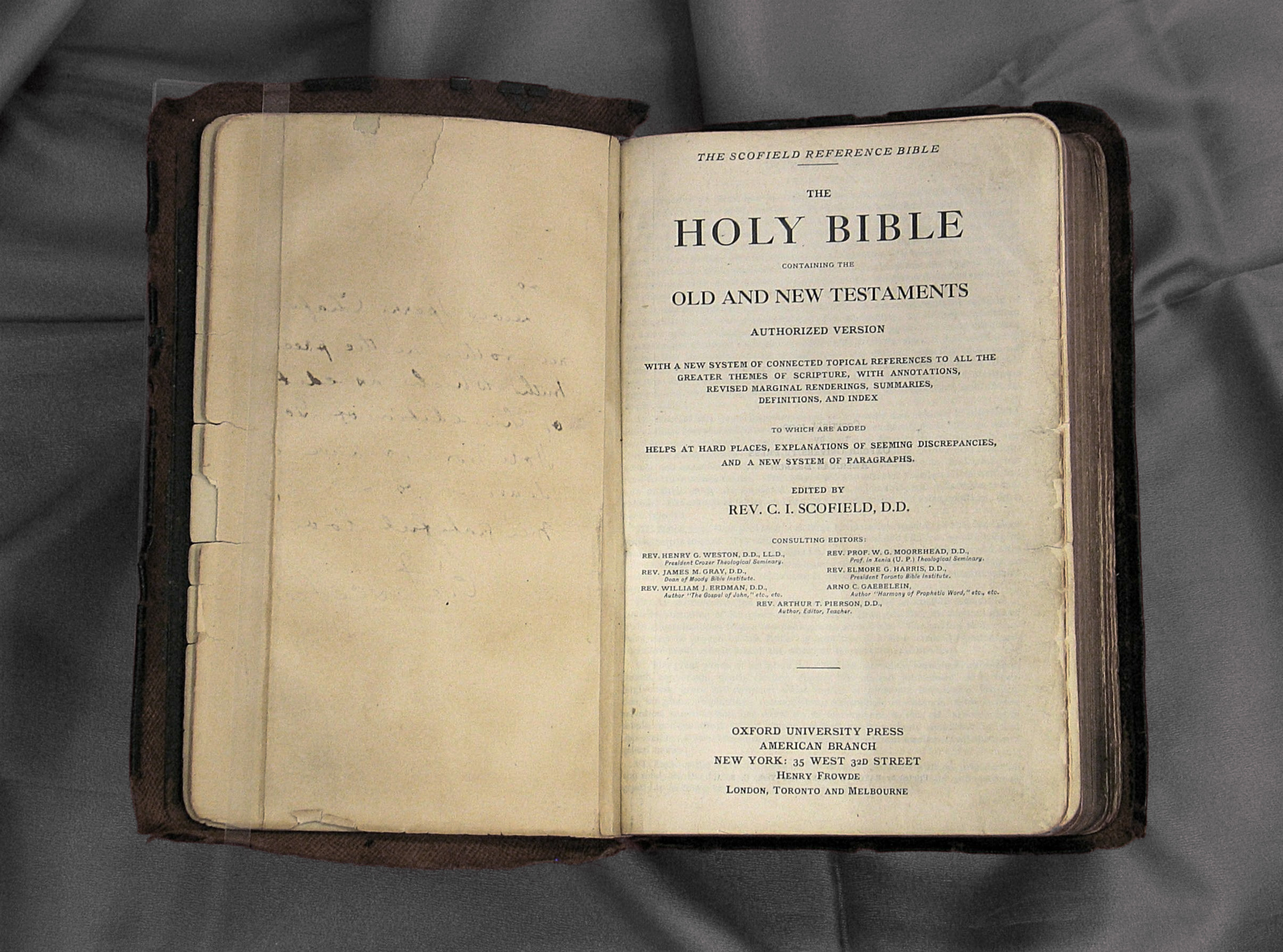
When the Scofield Reference Bible was first published in 1909, it was the first of its kind and it would go unchallenged for nearly 50 years. It wasn’t a new translation; rather it was the KJV with custom headers and study notes in the margins. The views expressed in these notes would come to shape much of the American theological landscape, predominately through the 1960s-1990s.
Focusing heavily on Eschatology(end-times), the notes weave parts of the Old and New Testaments together, as though all were written at the same time by the same people. This is a favorite device of modern dispensationalists, who essentially weigh all scripture against the unspoken and preposterous theory that the older it is, the more authoritative it is. The borrowed ideas in the headers and notes were later popularized under the labels and definitions that have evolved into common usage today: “pre-millennialism,” “futurism,” “dispensationalism,” “Judeo-Christianity,” and most recently, the highly political movement openly called “Christian Zionism.”
When World War I began, Christian optimism took a hit, and the Scofield Reference Bible provided a pessimistic worldview that seemed prophetic. By the end of World War II, the Scofield Reference Bible was the best selling Bible in the whole nation.8 Being the first of its kind, Scofield’s Reference Bible began to shape the theology of popular Christianity in America and Europe. Many historians show how the dispensational theology of Scofield’s Bible led to Christian apathy when Hitler and Mussolini rose to power. Literature began to rapidly spread, claiming that “these men could be the antichrist; therefore, we should let them rise in power because this will lead to our soon rapture.”9 Dispensationalism promoted a “hands-off” policy regarding Nazi persecution of the Jews since they believed it was a sign of “the Great Tribulation.” Pleas from Europe for assistance for Jewish refugees fell on deaf ears because “hands-off” meant no helping hand.10Who was behind the creation of the Scofield Reference Bible?
MISTER SCOFIELD
The author, Cyrus I. Scofield, allegedly had a Doctorate in Divinity, but that has since proved false.11 Originally a lawyer and later involved in politics, he was not a Bible scholar as one might expect, but rather a political animal with charm and talent for self-promotion. Scofield was a dubious character with a criminal history, who embezzled money, was forced to resign from politics, had a severe drinking problem, served six months in jail for forgery even after his conversion to Christianity, and abandoned his wife and daughters.
Researchers believe that as one of Scofield’s closest friends, Samuel Untermeyer, a lawyer and one of the wealthiest Zionists in America, funded the writing of the Reference Bible. Lavish living conditions in Europe were also funded where Scofield would come to be linked to Oxford University Press. It seems Scofield’s interest in Darbyism was shared by Oxford, which published and distributed the Scofield Reference Bible.12 Scofield stated he was paid handsome royalties by Oxford, allowing him to buy many properties.
The idea of a Rapture and its merry gang of end-times beliefs got a major boost from being taught in Bible colleges popping up all across America. Oxford University Press made sure distribution took place through these various popular seminaries and that every new pastor left school with one in hand. It was through this forced and artificial proliferation of the Reference Bible that these beliefs became solidified in the minds of evangelical churches. There was a clear and concerted effort to influence Christian belief.
POP-CULTURE CHRISTIANITY
Doom and gloom dispensational theology has created boogeyman after boogeyman over the decades. There is always a new Anti-Christ and a new Mark of the Beast to be fearful of after the last one gets proven to be false. Later followed by a popular movie, the best selling book of 1970 was The Late Great Planet Earth, by Hal Lindsay. In a misinterpretation of Matthew 24:34,13 Lindsay predicted that Jesus’ return might be within “one generation” of the establishment of the modern nation-state of Israel. He predicted that the end times would occur in the 1980s, where he utilized current fears of Soviet communism and nuclear weapons to draw allegories to apocalyptic imagery. In his work, The 1980’s: Countdown to Armageddon, Lindsey predicted that “the decade of the 1980s could very well be the last decade of history as we know it.”
Left Behind, a series of 17 best-selling religious fiction novels by Tim LaHaye and Jerry B. Jenkins, is responsible for pushing the idea of doom and gloom into the forefront of popular Christianity in the 90s. After selling 60 million copies, the book series was followed up by four different films and a host of video games. LeHaye and Jenkins replaced Lindsay’sRed Scare of the 70s, with budding Islamophobia and the hysterical scare of Y2K in the late 90s, evangelicals were primed for rapture fever. David Carlson, a Professor of Religious Studies, writes that the Dispensationalist theology underpinning the Left Behindseries promotes a “skewed view of the Christian faith that welcomes war and disaster, while dismissing peace efforts in the Middle East and elsewhere—all in the name of Christ.”14
Despite the Rapture and it’s accompanying Dispensational beliefs not being held by most orthodox Christian scholars and theologians today, they continue to permeate much of evangelical lay theology in America. Undoubtedly, this can be mostly attributed to the widespread distribution of the Scofield Reference Bible which, sometime after it’s authors death, was re-released with edits four times up to 1967, with steeper Dispensational and Zionist leanings with each release.
Every prediction has proved to be false, and after 50 years of false predictions about the end of the world, we should probably stop paying attention. The clear historical record shows where these doom and gloom beliefs came from. The teaching that Christ’s words in Matthew 24, Daniel’s prophecies, and the book of Revelation are all referring to future events is a new system of beliefs that started at the Reformation, developed in the 1800s and became popular in the late 20th century. You may have just assumed that Christians have always believed this way, but it does not have the support of Church history or Scripture and will go down in the history books as an unfortunate fad.
WHY IT ALL MATTERS
Doom-and-gloom end-times beliefs are an example of what can happen when Christians rely on popular teachings rather than reading scripture for themselves. The enemy is a crafty deceiver. God saves us not by snatching us out of the world but by coming into the world to be with us. The escapist mindset behind much of the Rapture theology should cause worry. We’re supposed to be bringing the Kingdom down to earth, not escaping earth to avoid hardships. The world is not destroyed; it is renewed.
End-times theology has produced a Christianity that is wide-spread but has so little cultural influence because it recognizes no long-term hope of success. In contrast, the true Gospel of the Kingdom of God has a plan; it motivates us to pursue it, and understands that we as Christ’s ambassadors are to build into his nation and think long-term.
The Prince of Peace has established a new kind of government, a government characterized by ever-increasing peace. Weapons of war are being transformed into instruments of agriculture (Isaiah 2:4). This was Isaiah’s hope (Isaiah 9:5). What had been prophesied for generations became fulfilled with the coming of Jesus, the Prince of Peace!
The doom-obsessed end-times beliefs of Dispensationalism attempts to take that hope of Peace away. They say that Jesus is the Prince of Peace, but that peace is not for now, only when Jesus comes back again. This is not what Scripture teaches. War can never achieve peace. The Dispensationalist version of the biblical storyline requirestribulation and war in the Middle East, not peace plans. That is the most terrifying aspect of this distorted theology. Such anticipation of violence is the very reason why we cannot afford to give in to this false idea—because real people’s lives are at stake.
Michael de Semlyen, All Roads Lead to Rome (Bucs, England: Dorchestor House Publications, 1991) 202-203.
Rev. Joseph Tanner, Daniel and Revelation, 16-17; as quoted by Froom, Vol. 2, 487.
George Eldon Ladd, The Blessed Hope: A Biblical Study of the Second Advent and the Rapture (Grand Rapids, MI: Eerdmans Publishing Company, 1956) 37-38.
Robert Caringola, Seventy Weeks: The Historical Alternative (Springfield, MO: Abundant Life Ministries Reformed Press, 1991) 31.
Dr. Ron Thompson, Champions of Christianity in Search of Truth (Brushton, NY: Teach Services, 1996) 91.
Dave MacPherson, The Rapture Plot (Simpsonville, SC: Millennium III Publishers, 2000) 28, 249-252.
Dave MacPherson, The Incredible Cover-Up: Exposing the Origins of Rapture Theories (Medford, OR: Omega Publications, 1980) 30-32.
Gaebelein, 11.
Woodrow, Ralph. Great Prophecies of the Bible. Riverside, CA: Ralph
DeMar, Gary. Last Days Madness, 4th ed. Atlanta, GA: American Vision, 1999.
The Incredible Scofield and His Book by Joseph M. Canfield
A History of The Plymouth Brethren by William Blair Neatby
Matthew 24:34 was used as proof, “Truly I tell you, this generation will certainly not pass away until all these things have happened.” Since the Bible teaches that a generation is forty years, this led millions of Christians to believe and teach the rapture would occur in 1988. Thus, Edgar Whisenant sold 4.5 million copies of his book, 88 Reasons Why Jesus Will Return in 1988. For more information on this verse, read our article here.











 Truth Prospector